
Works with the tools your agents already use
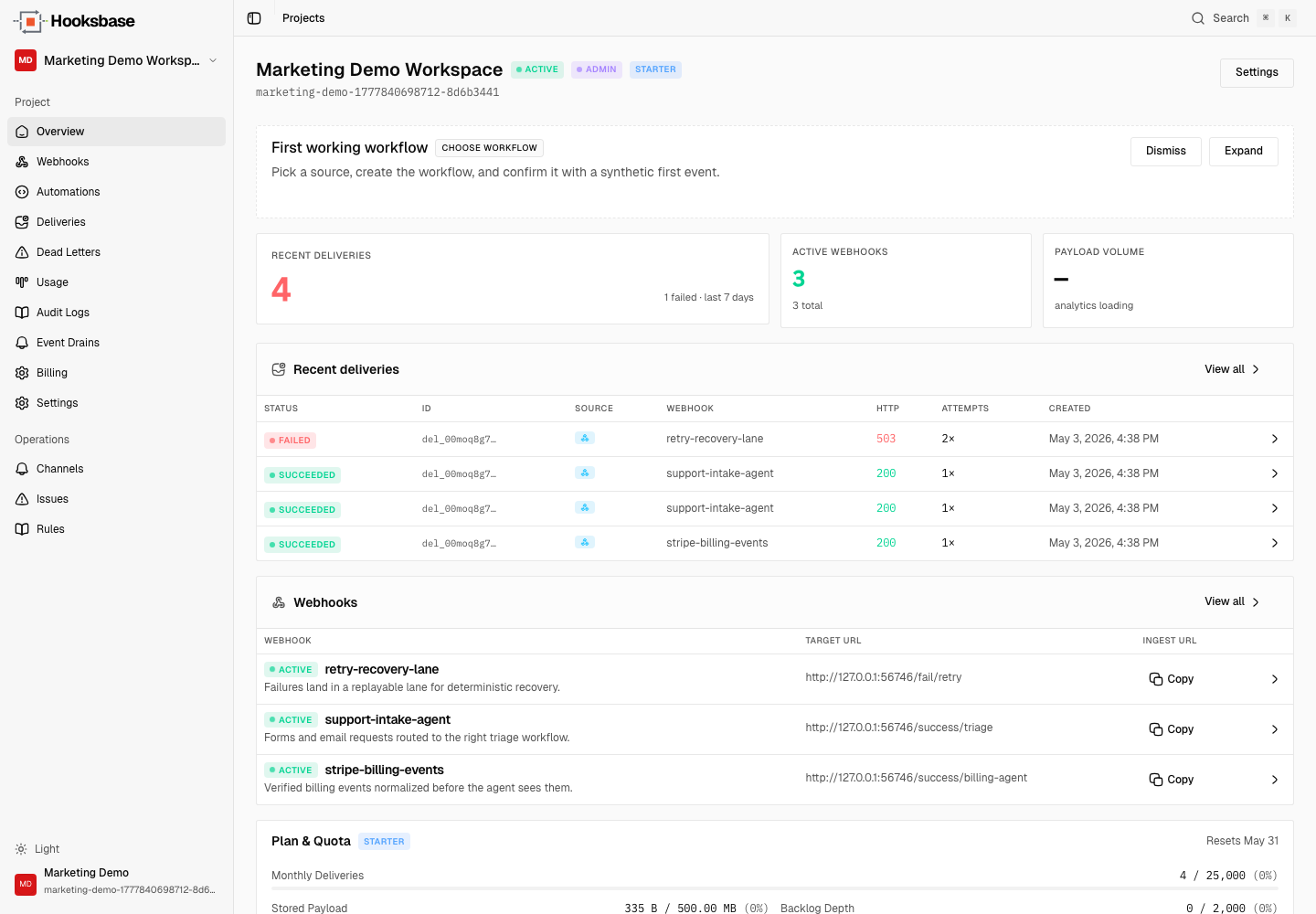
One dashboard for every event your agent needs.
For your agent
Give your agent reliable events from anywhere.
Visibility
See every event reaching your agent
Inspect payload, attempts, responses, DLQ state, and replay lineage from the dashboard. No more blind debugging.
Routing
Send the right event to the right agent
Match on payload fields, headers, content type, or verified provider metadata with priority rules.
Recovery
Replay failed events when the agent wakes up
Deterministic replay from persisted snapshots — even after you change the transform config.

Channels
More than HTTP
Trigger your agent over email, embedded forms, and cron schedules — all into one delivery pipeline.
Automations
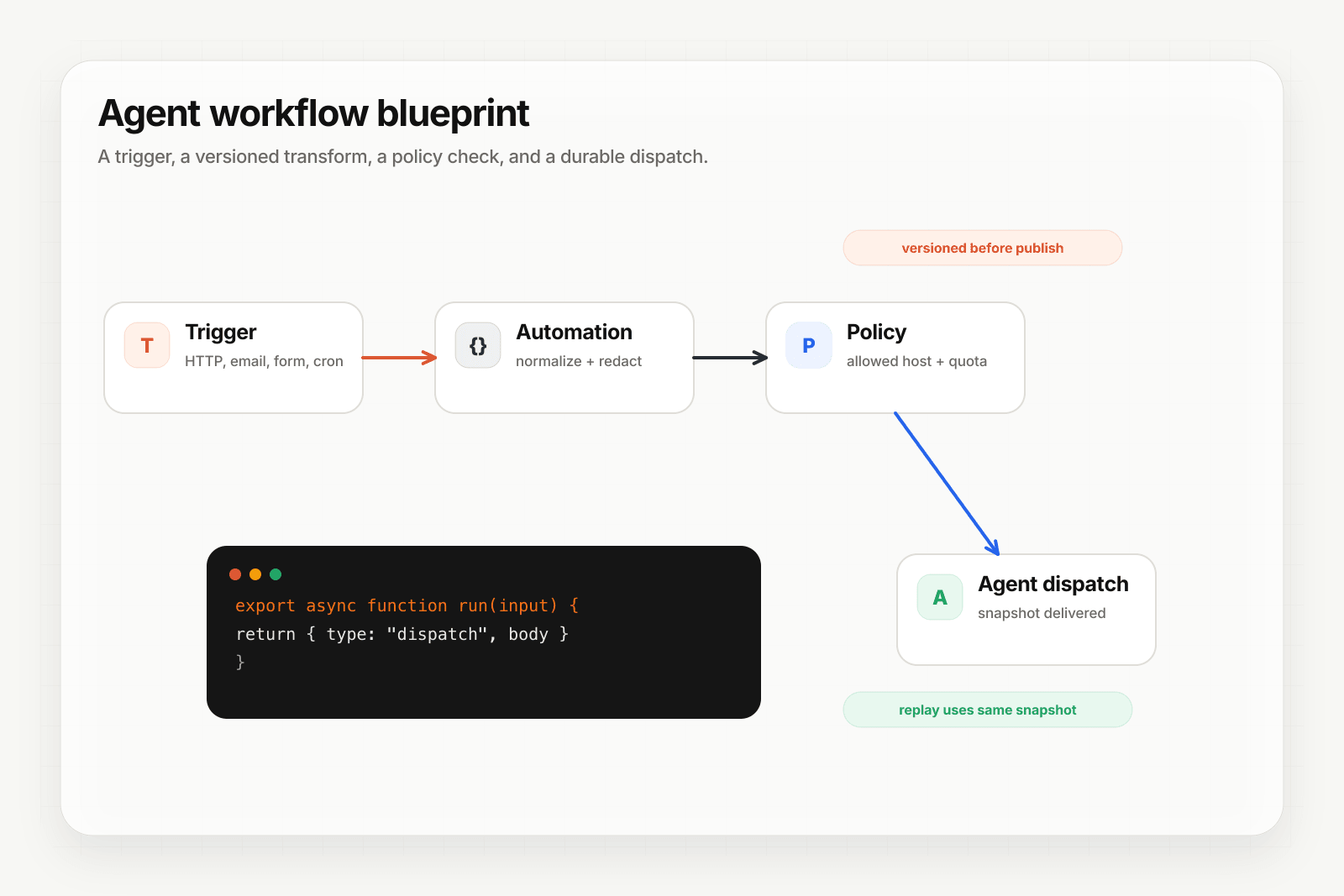
Run logic before your agent sees the event
Use Code Mode transforms to normalize, redact, and shape a versioned dispatch snapshot in the event path.
Production ready
When your agent hits production, the event layer is ready.
Blueprints
Start with an agent workflow, not a blank page
Six guided blueprints for HTTP, email, forms, queues, object storage, and scheduled agent triggers.
Providers
Trust what reaches your agent
Verified inbound for Stripe, GitHub, Clerk, Slack, and Resend — signatures checked before persistence.
Scheduling
Wake the agent on a cadence
Recurring JSON triggers through the same ingest, routing, and delivery pipeline.
Observability
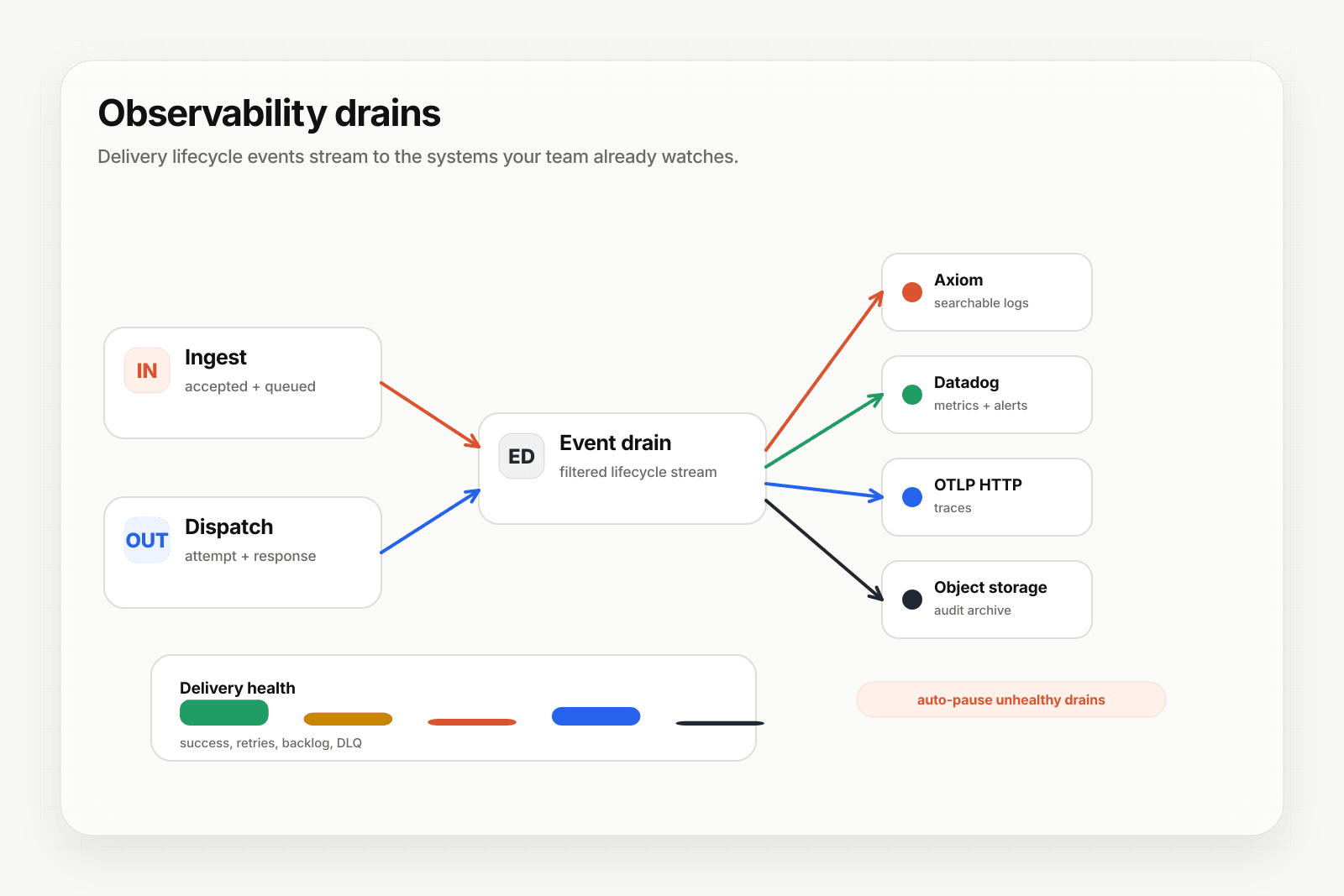
Stream events where your team already looks
Event drains to HTTP, Axiom, Datadog, object storage, or OTLP HTTP.
Frequently asked questions
How can events get into Hooksbase?
Four ways, all of which land on the same delivery pipeline: an HTTP POST to an ingest URL, an inbound email address, an HTML form post, and a scheduled cron firing. Inbound HTTP from Stripe, GitHub, Clerk, Slack, and Resend can additionally be signature-verified with a provider pack before the event is persisted, so an unverified payload never reaches your agent.
Where can Hooksbase deliver events to?
Any HTTP endpoint, plus four typed cloud destinations: AWS SQS, AWS EventBridge, GCP Pub/Sub, and S3-compatible object storage. Every destination gets the same delivery guarantees — retries with exponential backoff, optional strict ordering, Standard Webhooks-compatible signing, and a dead-letter path for anything that fails terminally.
Do I have to build webhook plumbing to use it?
No. Signature verification, retry scheduling, ordering, idempotency, payload storage, replay, and the dead-letter queue are the product rather than things you implement against it. What you provide is a destination and, if you want to reshape the event before your agent sees it, an Automation — a versioned transform that runs in the event path.
Is there a free tier, and is Hooksbase self-hostable?
The free tier is 5,000 deliveries per month with no credit card, and it is the intended way to evaluate the product. Hooksbase is hosted-only — it runs on Cloudflare Workers and is not self-hostable — though the client SDK and CLI are published under Apache-2.0 as @hooksbase/sdk and @hooksbase/cli.
What is Hooksbase?
Hooksbase is event infrastructure for AI agents. It ingests events over four channels — HTTP, email, HTML form, and scheduled cron — verifies them, routes them by rule, runs versioned Automations in the event path, and delivers them to HTTP and cloud destinations (AWS SQS, AWS EventBridge, GCP Pub/Sub, and S3-compatible storage) with retries, strict ordering, Standard Webhooks-compatible signing, deterministic replay, and a dead-letter path. It is a hosted service, runs on Cloudflare Workers, is operated at hooksbase.com, and is not affiliated with — and shares no code or ownership with — other similarly named webhook, hook, or tunnelling tools.